
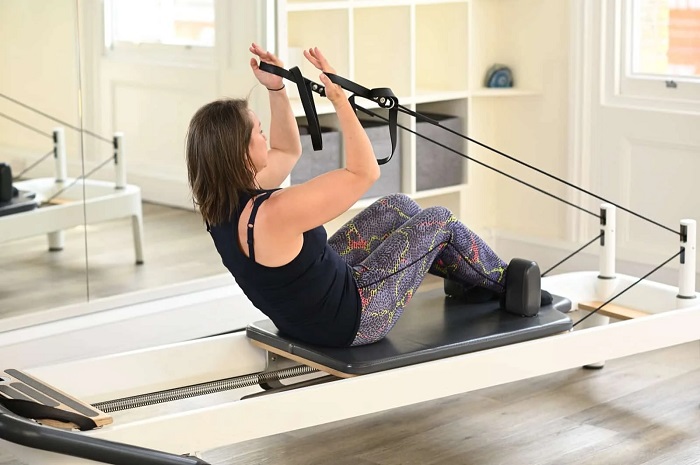
Spring selection is one of the most visible ways to adjust a Reformer exercise, but it is often misunderstood as a simple light-to-heavy scale. On a pilates reformer, additional spring tension may increase resistance in one exercise while providing greater assistance or carriage stability in another.
The correct setting depends on movement direction, body position, equipment design and the purpose of the exercise. More springs do not automatically indicate greater strength or a more advanced participant.
Springs Create Force as They Lengthen
Reformer springs generally produce more force as they are stretched. This means resistance can change as the carriage travels.
The participant may experience relatively little spring force near one end of the movement and substantially more near the other. Carriage range therefore affects the total demand.
Two people using the same spring configuration may experience the exercise differently if one moves through a larger range or uses a different body position.
Spring colour alone does not describe the complete load.
Resistance Depends on Movement Direction
During footwork, the legs typically move the carriage away against spring tension. Increasing tension may require more force during that phase.
During the return, the springs pull the carriage towards the stopper. The participant must control that assistance instead of allowing the carriage to accelerate.
In another exercise, heavier springs may support the carriage and make the starting position feel more stable. A lighter setting may create greater balance or trunk demand because there is less assistance.
This is why spring choices must be interpreted within the specific exercise.
More Stability Can Improve Learning
A participant unfamiliar with the equipment may benefit from a stable carriage while learning hand, foot and body placement.
Greater spring tension can sometimes reduce unwanted carriage movement. This allows attention to remain on the exercise rather than on fear that the platform will move unexpectedly.
Once the participant understands the setup, the instructor may reduce assistance or change the springs to create a new control challenge.
Starting with stability is not avoiding progress. It can establish the conditions required for useful progression.
Lighter Springs Are Not Always Easier
During plank-like positions or exercises requiring the participant to stabilise a moving carriage, lighter springs may provide less support. The shoulders and trunk can face greater control demands.
A participant expecting a lighter setting to feel gentle may be surprised by the instability. This makes clear instruction essential.
Reducing spring tension should not be used casually as a way to make every exercise more advanced. The participant still needs sufficient control, equipment familiarity and a reliable exit.
The instructor should explain whether the lighter setting changes resistance, assistance or stability.
Heavier Springs Can Change Technique
When resistance becomes too high, the participant may shorten the range, use momentum or shift load towards a stronger side.
These compensations can make the exercise look powerful while reducing its original purpose. A high spring setting is only useful when the participant can control both the outward and return phases.
Signs that the setting may need adjustment include:
- Carriage speed changing abruptly.
- Repeated impact at the stopper.
- Breath-holding.
- Loss of foot or hand position.
- Uncontrolled pelvic movement.
- Reduced range without intention.
- Inability to pause or reverse smoothly.
The solution may involve fewer springs, a different body position or a simpler exercise.
Machine Design Matters
Spring colours and tensions are not universal across manufacturers. Different Reformer models may also have different carriage weights, pulley systems and dimensions.
A setting used in one Singapore studio may not feel identical elsewhere. Participants should not insist on a particular colour combination without considering the equipment.
Spring age and maintenance can also influence feel. Studios need inspection and replacement procedures based on manufacturer guidance.
A participant’s personal training log should identify the machine or studio when spring comparisons matter.
Spring Choice Is Only One Variable
Exercise demand can also change through:
- Carriage range.
- Tempo.
- Lever length.
- Number of support points.
- Body orientation.
- Repetition count.
- Hold duration.
- Transition complexity.
Before adding springs, the instructor may ask the participant to slow the return or use a more consistent range.
This can increase muscular control without changing the equipment.
Progress should not be reduced to moving through a sequence of heavier colours.
Communicate the Setup Clearly
In a group class, participants need precise instructions before changing springs. The instructor should allow enough time for everyone to confirm the configuration.
Members should not copy the person beside them. Individual experience, exercise variation and machine position may differ.
If the setup feels unexpectedly unstable or heavy, the participant should stop and ask. Continuing through confusion can make the carriage difficult to control.
Late entry may be unsuitable if important equipment guidance has already been missed.
Track Response, Not Only Springs
A useful exercise record may include the spring setting, range, tempo and perceived effort. It should also note whether the carriage remained controlled.
Progress can mean performing the same configuration with:
- Smoother speed.
- Better breathing.
- Greater controlled range.
- Less gripping.
- More consistent repetitions.
- A calmer transition.
- Improved left-to-right control.
These outcomes often matter more than adding another spring.
Let the Exercise Determine the Setting
At Yoga Edition, participants can use instructor guidance to understand how spring choices affect each Reformer exercise.
The appropriate setting creates enough assistance, resistance or stability to serve the movement objective. It should not be selected to demonstrate toughness.
Springs are tools within a larger mechanical system. Once participants understand that their role changes with direction and setup, Reformer work becomes easier to interpret. Challenge can then be progressed through better control rather than an automatic search for the heaviest configuration.